
Behind the scenes
Before I knew it, we’d entered our fourth year.
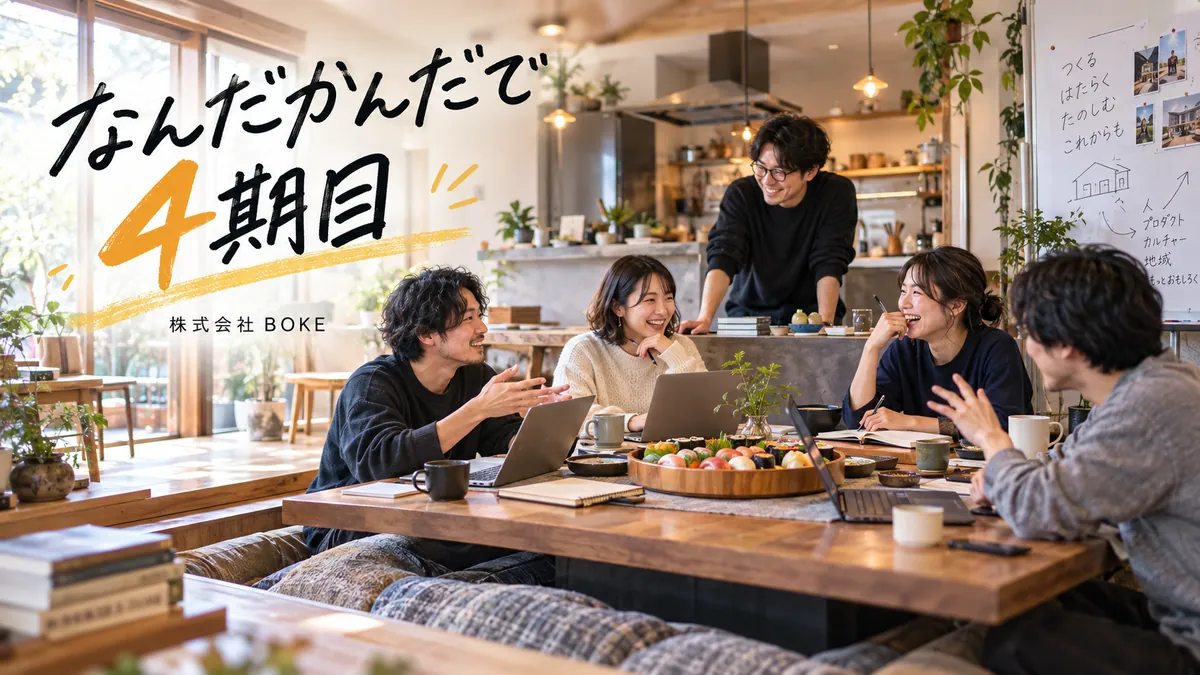
Hello. I’m Yamada, CEO of BOKE Inc.
Our third fiscal year ended on October 31, 2026, and on November 1 we entered our fourth.
It will soon be 3 years since we started the company in December 2023.
Wanting to look back on this past year, I went back through our company Slack and calendars for the first time in a while.
Since this is a milestone, in this post I’d like to take the opportunity to look back on BOKE Inc.’s third fiscal year.
From a 9-tatami one-room apartment to a house in Meguro City.
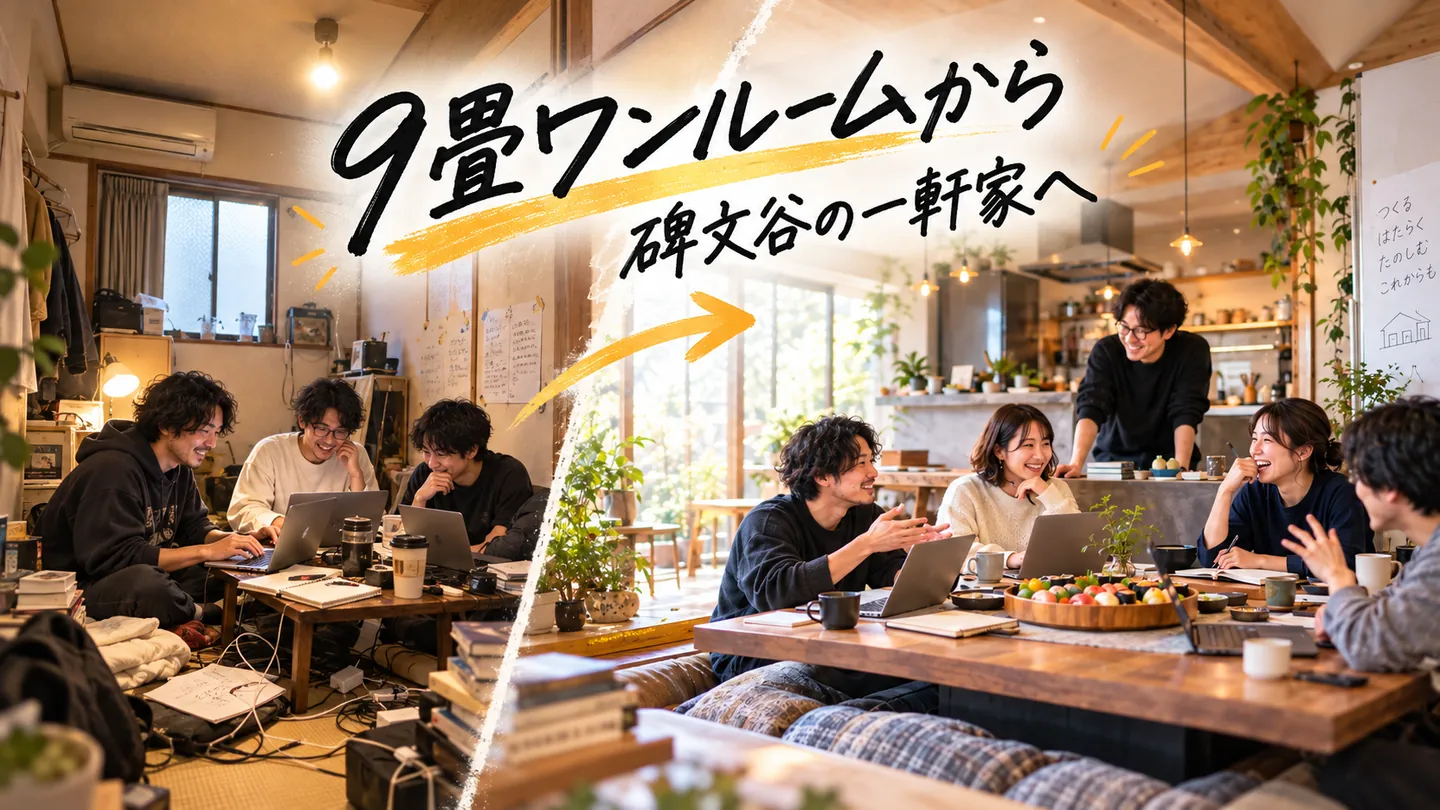
When we started out, our workplace was a one-room apartment of about 9 tatami mats.
Three of us guys, sprawled on the floor with our laptops open, building websites and developing systems.
Back then we had no services of our own, and every day was about bringing in revenue by working through the jobs we were asked to do, one by one.
“We can do websites. We can do LINE. We can build systems, too.”
I thought being able to do anything was our strength, but flip that around and it also meant it was hard to tell what kind of company we were.
I was pretty slow to realize this, but looking back, I think all that struggling is what laid the foundation we stand on today.
From there, little by little, more work came our way, and after a stint in Mita, Minato City, our office is now a house in Himonya, Meguro City.
Our current office has both a kitchen with a counter and a sunken kotatsu table. There’s alcohol too, and it’s set up so people can stay overnight.
It may be quite different from a typical IT company’s office, but we chose it on purpose. That’s because I had a gut feeling that as AI develops, the value of what happens offline is rising in relative terms. In fact, here we invite business owners over to eat sushi, friends drop by to hang out, and sometimes we even do nagashi somen (flowing noodles).
Of course, we do work here too (haha).
Why did we choose a place like this instead of an ordinary office?
It’s because I believe the place where work is born isn’t necessarily a meeting room.
Something we chatted about casually over a meal leads to a new project. Someone a friend brought along becomes a work partner before you know it. People who just happened to be there at the same time start something new together.
In fact, that happened again and again over the past year.
These days, with AI, making documents, doing research and developing systems can all be done far more efficiently than before.
That’s exactly why I feel that, conversely, people getting together in person is coming to mean more.
Rather than making everything efficient, I want to use the time that efficiency frees up for meeting people and thinking about new things.
Our current office is also a place that gives shape to that way of thinking.
From “We can build anything” to “We have our own service.”
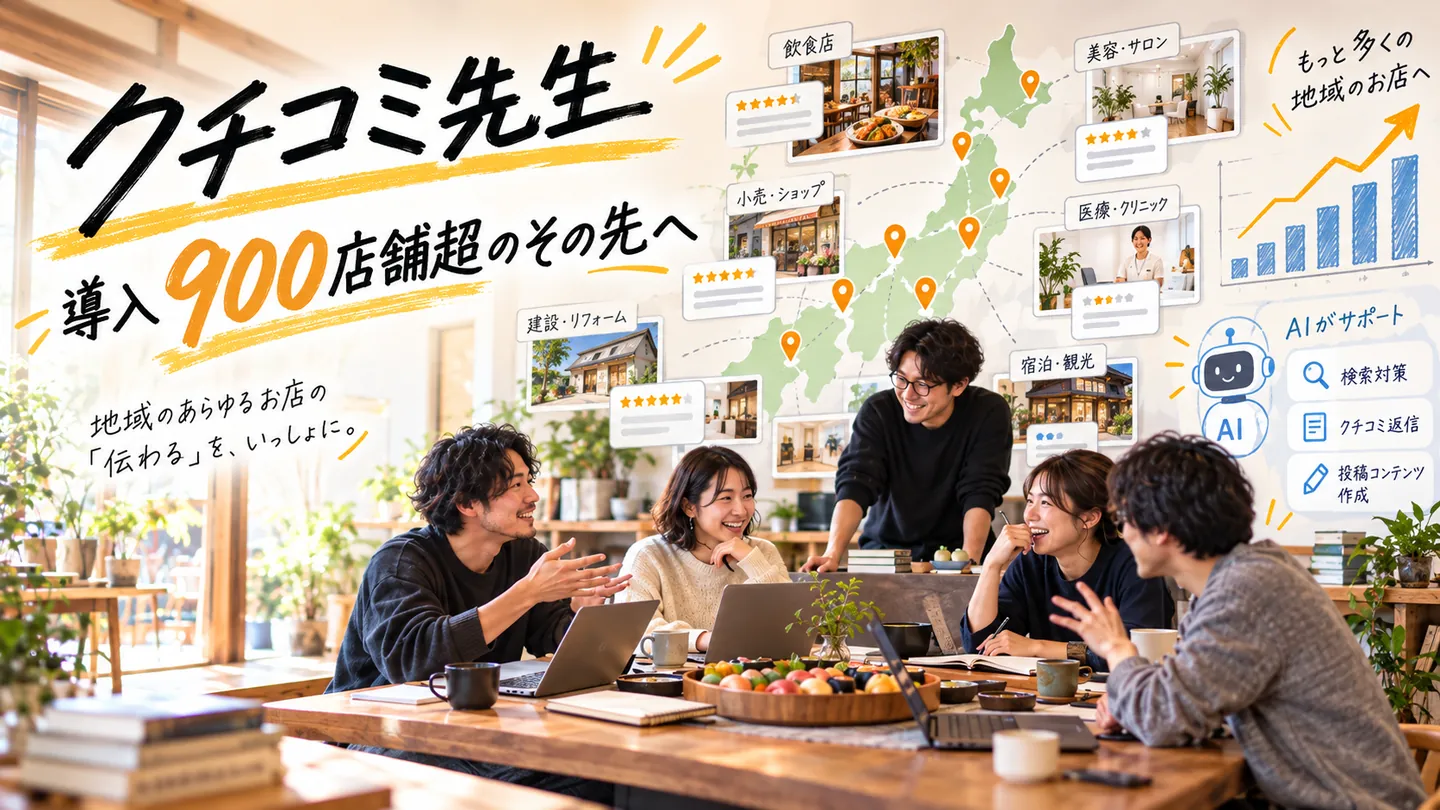
On the business side, our flagship service, Kuchikomi Sensei, grew substantially.
The number of stores using it, which had passed 400 around November 2025, is now over 900.
We’re grateful that customers in all kinds of industries use it, including hair salons, bodywork clinics, restaurants and medical clinics.
Originally, our business centered on contract development. Contract development is work where we build each system, one at a time, to match a client’s requests. It lets us put our own skills to use, and it’s a business we still value today.
On the other hand, it’s basically work where you only earn as much as you build. When I found myself wanting to deliver value to many more customers, I came to believe we needed to grow a service of our own.
It was in the middle of all this that Kuchikomi Sensei was born.
What sparked it was the burden on the ground that I sensed while working on customer attraction for stores.
People at stores are already busy enough with their real work alone, such as cooking, treatments and serving customers.
I was involved in running a café myself, and you’re expected to handle everything from updating Google Maps and replying to reviews to posting on social media and managing a website. It’s really quite tough, and even though you know it’s important, you just can’t get to it all.
So couldn’t we use technology to cut down on those tedious parts?
We built the service from that idea, and we’ve been adding features little by little ever since.
That said, I don’t think for a moment that it’s finished just because it has passed 900 stores.
If anything, it’s precisely because the number of stores has grown that new challenges keep coming into view, one after another.
Work that wasn’t a problem with 1 store becomes a heavy burden with 100 stores. Getting customers to sign a contract is also a different matter from having them keep using it and actually feel the results.
Now, we’re evolving it into a service that can support stores’ customer attraction on an ongoing basis, covering not only collecting and replying to reviews but also Google Maps, websites and AI search.
I’m glad the number of stores using it has grown. But what we can truly be proud of comes after that, when we’ve contributed to our customers’ businesses.
In our fourth fiscal year, I want to dig even deeper into that.
We were eating sushi, and ended up starting a sushi business.
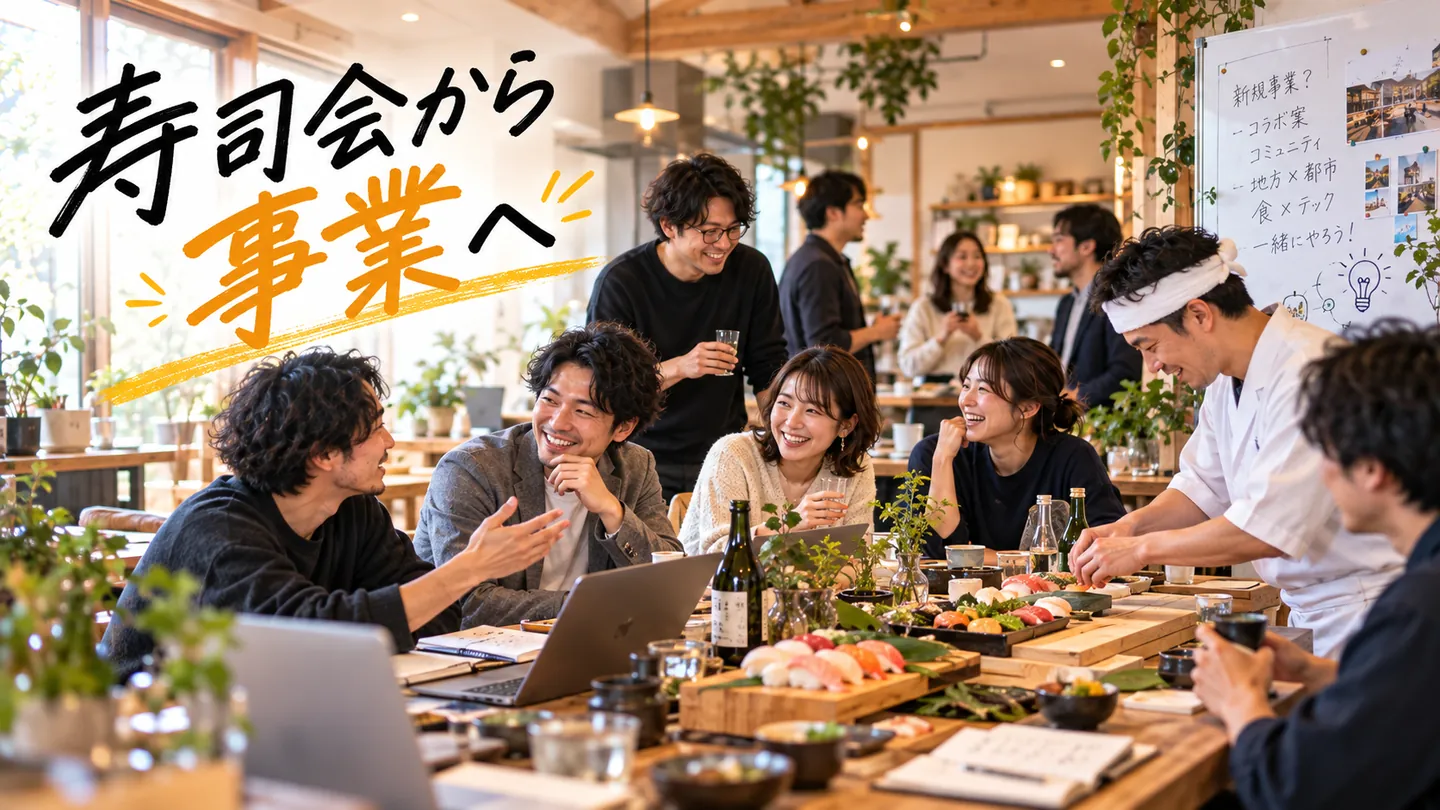
Another interesting thing about this past year was how our business branched out.
Today, in addition to web and system development and Kuchikomi Sensei, we’re also working on Arekore Sensei, an AI-powered business support service, and even a sushi catering business.
An IT company doing sushi?
Some of you may be thinking that.
Even I think it’s a somewhat unusual mix of businesses.
But it’s not as if we were thinking “Let’s enter the sushi market” from the start.
We had originally been holding sushi socials at the office; people gathered there, connections formed, and little by little the talk turned to developing it into a business.
In fact, we’ve started getting inquiries about sushi catering for offices and social events.
I don’t think every new business has to start from a meticulous business plan.
There’s an interesting-looking opportunity right in front of us, there’s something we can do, and there are people who’d be happy about it.
Then we give it a try.
Of course, to keep something going as a business, you need profitability and quality control. Being fun alone doesn’t make it work.
Still, I think there are things that would never have come about if we had judged even the very first step on rationality alone.
Being able to keep taking on challenges like this may also be one of the strengths that only a small company has.
Our team grew, and so did the difficulty of running a company.
And the biggest change over this past year, I think, really was our organization.
Development, sales, customer support, production, admin.
We’ve gained more teammates who take charge of each of these areas, and the way we work has changed from before.
In the early days, it wasn’t uncommon for me to do the sales myself, plan things, make the documents, check the production work and even handle the billing.
Now, team members think for themselves and move their work forward, and sometimes new conversations with customers get started without my even knowing.
I’m genuinely happy about this change.
At the same time, I also learned that a company doesn’t naturally get stronger just because it has more people.
If anything, having more people brought problems we couldn’t see before into clear view.
Who takes final responsibility? How do we confirm that a job is done? Where do we gather information? How do we keep the quality of our customer service consistent?
Even when each person is working hard, that doesn’t necessarily mean things work well as a whole.
In fact, this year we reworked how we manage tasks many times.
We tried managing them in spreadsheets, tried building our own management tool, tried using AI to check on progress.
Even so, there were quite a few times when the final checks and decisions all ended up landing on me.
This is one of the big things from our third fiscal year that I need to reflect on.
To grow as a company, we need not only to bring talented people together, but also to build an organization where everyone takes responsibility for their own role and we can entrust work to one another with confidence.
We’re still very much a work in progress, but I want to keep improving little by little.
From Mountain Field to BOKE Inc.
In 2026, we converted from Mountain Field LLC, the company we had been since our founding, to BOKE Inc.
BOKE.
When you first hear it, it might sound like a slightly silly company name.
But in all seriousness, we really like this name.
The mission we stand for is “Question common sense.”
And our slogan is “Don’t be a good kid. Be a good individual.”
This doesn’t simply mean that we want to do unusual things.
Maybe we don’t need to force ourselves to fit what’s generally considered right, or the roles the people around us expect us to play.
Each of us has a different personality and different strengths, so maybe there’s room for ways of working, and companies, that make the most of them.
That’s the thinking behind it.
Of course, being free is not the same as not taking responsibility.
When customers give us work, we deliver quality beyond their expectations. When we promise something, we see it through properly.
As long as we value those basics, there’s room for freer choices in how we work and how we build businesses.
A little unusual from the outside, but surprisingly solid when you entrust it with your work.
I think it would be fun if we could become that kind of company.
And on to our fourth year.
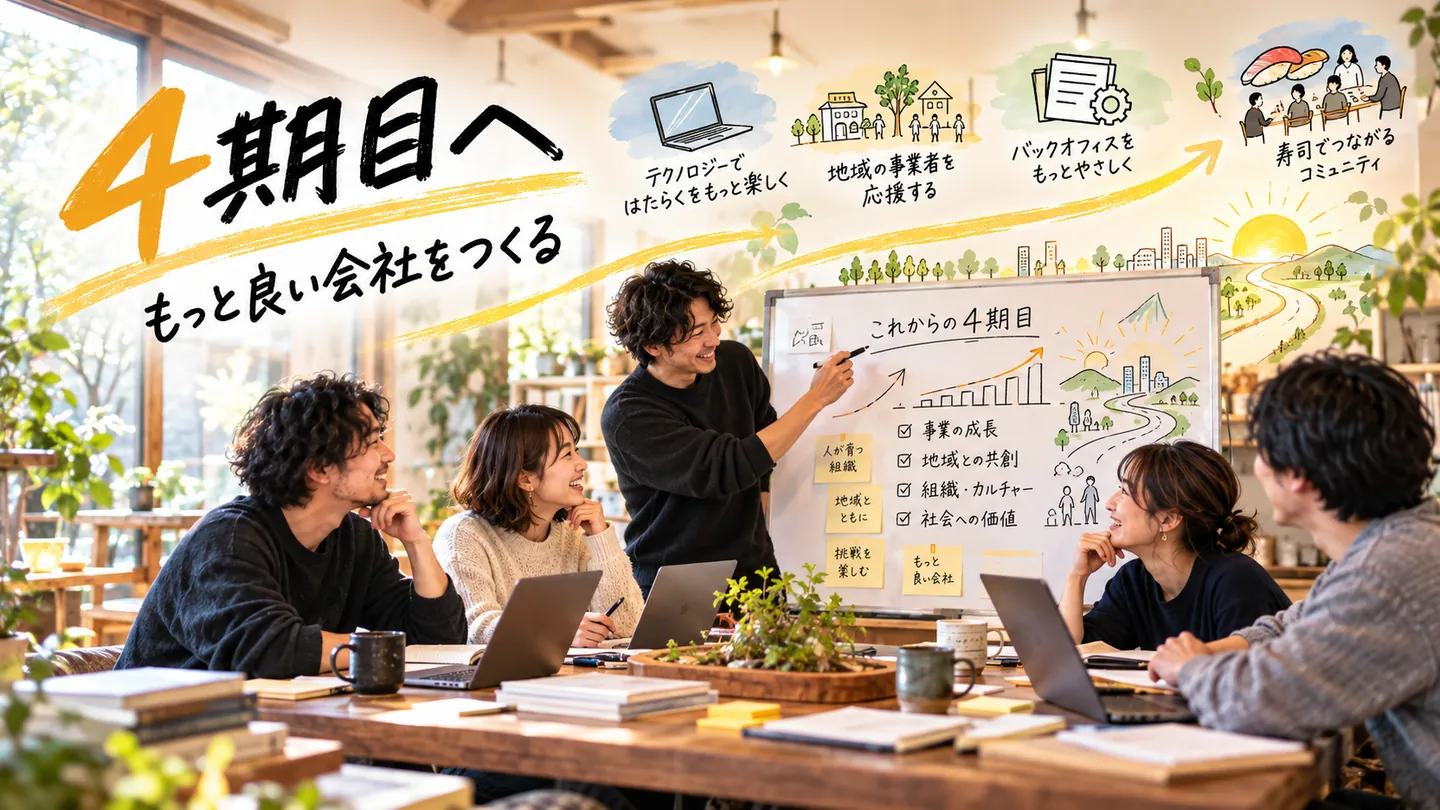
Looking back, our third fiscal year was, above all, a year full of change.
Our company name changed, our office changed, our team grew and our businesses multiplied.
We were also fortunate in our connections with customers, and we became able to take on work we couldn’t do before.
At the same time, there’s a lot that didn’t go the way we wanted, and plenty of issues we still haven’t solved.
Still, compared with where we were 3 years ago, there’s definitely more we can do now.
And above all, I can now work together with my teammates on things I’d never have come up with on my own, and things I could never have made happen alone.
I want our fourth fiscal year to be a year of making the businesses we’ve started so far even stronger.
For Kuchikomi Sensei, we’ll look beyond the number of stores using it and engage more deeply with the results our customers get.
In contract development, we’ll make use of AI and new technologies to raise our quality and speed higher than ever.
With the businesses we’ve newly started, too, we’ll refine the value of each one and grow them into services people keep needing.
And as an organization, rather than relying on individual effort, we’ll build an environment where each of our teammates can bring their own personality and abilities into play.
The reality is that we’re still a long way from where we’re aiming to be.
Which is exactly why I’m also looking forward to what comes next.
By the way, this post was also left in our Slack on October 31, the last day of our third fiscal year.
“Improve, improve, starting with the next office sushi ♪”
The way we were still thinking about improving our sushi right up to the end of the fiscal year makes me think we really are a strange company (haha).
Even so, I want us to keep being a company where new ideas and new work come out of everyday moments like these.
Finally, I’d like to express my heartfelt thanks to our customers and business partners, who support us every day, and to the teammates who take on challenges alongside us.
We hope you’ll continue to support BOKE Inc. in our fourth fiscal year, too.
BOKE Inc.
Hirotaka Yamada, Representative Director
November 1, 2026
BLOG